FireReady VR: Translational Research with the Clemson University Virtual Reality and Nature (VRN) Lab
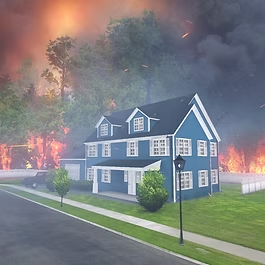
FireReady VR, developed with Clemson VRN, uses immersive wildfire scenarios to show how home preparedness choices affect risk and motivate real-world action.
Challenge
Wildfire risk is rising, but many households still ignore or delay basic preparedness steps like creating defensible space and hardening their homes. Checklists and brochures are easy to skim and forget, and they rarely make the consequences of inaction feel personal.
Approach
We focused on "The Experience of Consequence." Instead of a checklist, we built a narrative where users make choices about preparing their home for a wildland fire and then experience a visceral, high-intensity wildland fire event based on those choices.
Features
• Immersive community-scale wildland fire scenario
• Side-by-side comparison of prepared vs. unprepared homes
• High-fidelity fire, smoke, and environmental effects
• Narrative structure for education and emotional engagement
• Designed as a translational research tool with the Clemson University VRN
• Configurable for use in workshops, outreach events, and research studies
From discovery to measurable outcomes
Discovery
Hospital leadership identified the training gap and defined success metrics with our team.
Design
We conducted cognitive task analysis and designed the simulation architecture around measurable learning objectives.
Build
Our developers created the environment in Unity while researchers integrated biometric tracking systems.
Validate
Multiple cohorts trained in the simulation. We collected performance data and compared outcomes to traditional methods.
Deploy
The hospital integrated the simulation into their residency program with ongoing data collection and refinement.